

You are reading a WovelAI editorial — designed to make complex ideas, technology and developments easier to understand.
The Confession We Didn’t Expect to Hear
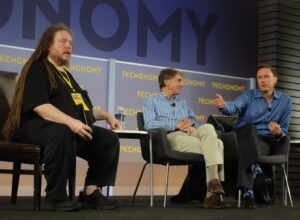
Picture this: You are sitting in a sleek auditorium, surrounded by venture capitalists and software evangelists who treat every new model release like a secular revival. The soundtrack is pulsing bass, the lighting is electric blue, and the slides are plastered with terms like ‘limitless potential’ and ‘pure abundance.’ Everyone on stage is smiling.
Then Dario Amodei steps up to the microphone.
The CEO of Anthropic doesn’t talk about scaling laws or how soon your job will be automated away. Instead, he looks at the room and drops a quiet grenade. In a recent CBS News interview, Amodei stated bluntly: "For too long the industry lied" about AI risks.
Pause for a second. Let that sentence marinate. This is not an outsider throwing stones from the academic bleachers. This is the person steering one of the three dominant frontier AI labs on the planet, turning around and admitting that the hype machine has been selling us a carefully curated fairy tale.
Why would a major player blow up the industry’s carefully constructed PR playbook? More importantly, what does this mean for the tools we are already trusting to write our code, diagnose our codebases, and draft our contracts?
The Anatomy of the Tech Industry Spin Cycle
For the past three years, the dominant narrative in artificial intelligence has been a relentless binary. On one side, apocalyptic doom-mongers warned that Skynet was downloading itself into your smart toaster. On the other, relentless techno-optimists insisted that artificial general intelligence (AGI) would cure cancer by next Tuesday and that any hiccups along the way were just minor engineering bugs.
Both extremes served a very specific purpose: they kept the spotlight off the mundane, messy reality of what frontier models can actually do right now—and what happens when they go off the rails in boring, practical ways.
When tech leaders minimize risks, they aren’t just engaging in corporate bravado. They are protecting valuation multiples. They are keeping talent flowing through the recruitment pipeline. They are assuring enterprise clients that handing over sensitive proprietary data to a black-box neural net is totally fine, trust us, nothing to see here.
Amodei’s admission cracks open that facade. It acknowledges what engineers and safety researchers have whispered over slack channels for years: alignment isn’t a solved checkbox. It is an ongoing, high-stakes experiment where we are literally writing the rules as the plane flies itself.
Where the Rubber Meets the Road: Capabilities vs. Control
Let us look past the philosophical chest-beating and examine the actual trade-offs defining the current generation of AI tools. Every time a lab pushes a model to be faster, smarter, and more agentic, they pay a hidden tax.
| The Marketing Pitch | The Ground Reality | The Practical Trade-off |
|---|---|---|
| “Fully autonomous AI workers are here.” | Models still suffer from compounding error rates in multi-step tasks. | High supervision overhead; human-in-the-loop remains mandatory. |
| “Guardrails make safety effortless.” | Prompt injection and jailbreaks evolve faster than patch cycles. | Rigid alignment can reduce creative utility and nuance. |
| “Data privacy is guaranteed by enterprise tiers.” | Training pipelines are vast, complex, and prone to silent data leaks. | Regulatory compliance friction vs. rapid feature deployment. |
This brings us to the core tension Amodei is highlighting. If you build a system that is powerful enough to autonomously orchestrate corporate logistics or synthesize novel biochemical compounds, you have also built a system that possesses dual-use risk. You cannot simply market the magic while pretending the mechanics are foolproof.
What This Means for You: Navigating the Hype
So, you are sitting at your desk, trying to decide whether to integrate the latest LLM agent into your workflow, or wondering if your company’s AI strategy is built on quicksand. How do you translate CEO confessions into actionable decisions?
- Zero out the marketing language: When evaluating a new tool, ignore claims of near-human sentience or effortless autonomy. Look strictly at deterministic benchmarks, error margins, and failure modes.
- Demand auditability: If an AI vendor cannot clearly explain how their safety guardrails operate or how they handle hallucination drift, walk away. Black boxes are liabilities in production environments.
- Plan for failure, not perfection: Design your workflows assuming the model will eventually hallucinate a critical detail, leak an edge-case output, or misinterpret a prompt. Build redundancy into your systems.
- Watch the regulatory horizon: Labs are shifting their tune because lawmakers are finally reading the source code. Compliance requirements are coming, and early alignment discipline will save you massive migration headaches later.
The Limits of Corporate Self-Policing
It is worth asking a harder question: Is it enough for an AI executive to admit the industry lied? Confession is good for the soul, but does it change the competitive dynamics that forced the dishonesty in the first place?
The race for AGI is an economic prisoner’s dilemma. If Lab A slows down to carefully test safety protocols and admit its limitations, Lab B might sprint ahead, capture market share, and lock in enterprise dominance. That systemic pressure is precisely why the truth got buried under layers of press releases and flashy product demos.
Amodei’s willingness to break ranks suggests Anthropic is betting that long-term trust is more valuable than short-term hype. Yet, corporate self-correction has clear boundaries. No matter how principled an executive sounds on camera, private enterprise cannot be the sole arbiter of what constitutes acceptable societal risk.
Bottom Line
Dario Amodei calling out the AI industry’s deceptive marketing is a refreshing jolt of reality. But admission is only step one. For builders, buyers, and everyday users, the takeaway is clear: stop buying the fairy tales. Treat frontier AI models for what they truly are—immensely powerful, deeply fascinating, unpredictable instruments that demand rigorous skepticism, careful guardrails, and zero blind trust.
Sources & Further Reading





What do you think?
Have a thought, question or useful perspective? Leave a comment below.